Punching Nazis: Force vs. Speech
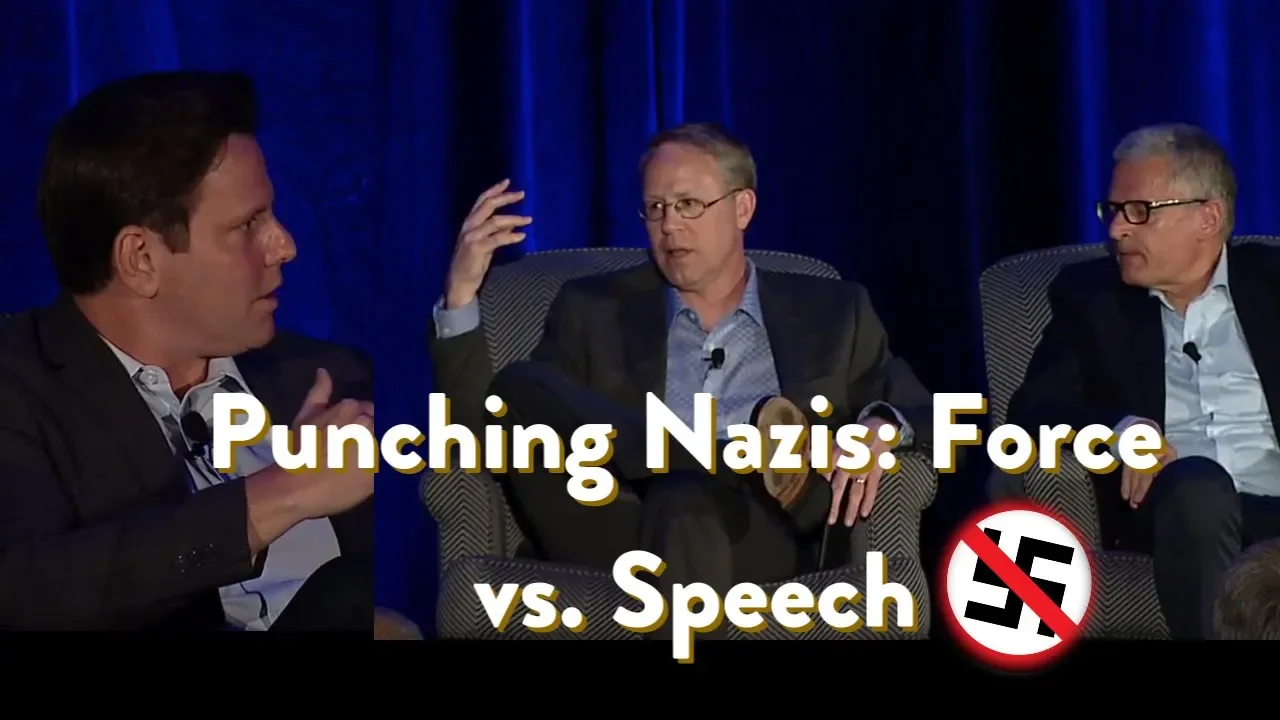
Here's a transcript of the dialog between Dave Rubin and Steve Simpson that's featured on this short clip:
Dave Rubin: The biggest issue with that logic, that the definition of a Nazi—or whatever label you want to use—will always expand, so if one person says, “It’s okay to punch a Nazi, it’s okay to punch Richard Spencer,” someone else will say, “Well, okay, if we can punch him, can we blow up his house?” I mean, what if his wife and kids are in there? Can we—what if it’s not a Nazi, but it’s someone with equally abhorrent views, like where—it’s just a train that you can’t stop.
Steve Simpson: That’s definitely part of it. I mean, one of the things I’ve been debating with people on Twitter and Facebook is, well, okay, you want to punch the Nazis, I guess we also should punch communists, right, and socialists too, because look what’s happening in Venezuela. I mean, they’re killing each other, that’s horrible, so somebody go punch Bernie Sanders. After that, it’s, if you want to look back to the Middle Ages, look what the Christians did, we gotta start punching Christians, you know, Muslims are killing people in foreign countries, them too—punch list, you know. And pretty soon, you know, the list is like, you know, it’s an endless list of everybody in history. And, I mean, so definitely this idea that we go after people for their ideas is abhorrent, even if their ideas are abhorrent, but we have to understand: There’s a way to define the line that Flemming was talking about. And, I mean, this is, you know, vastly oversimplified, but the line is individual rights, and we have to make a distinction between the use of force, either to threaten or to—the initiation of force to threaten others, threatening or actually using it against others—versus the use of ideas. So if a Richard Spencer—he can spout all of his nonsense, as much as he wants. What he can’t do is put those ideas into practice, because yes, those ideas do lead to violence if you really take them seriously and you follow them. He cannot go around and start attacking people, or threatening people, or banding together with other Nazis and saying, “We’re going to take over the country.” That is all illegal. And thankfully, in free countries, we already have systems of laws that deal with that. I mean, the criminal law does a really good job of that. But as Flemming pointed out, we’ve gotten to a point now where, I think in part, we don’t know where that line is, but also there are whole philosophies that hold that, in effect, ideas are really threatening. And part of the reason for that, I always put it as, look, if you want to defend the indefensible, if your ideas are stupid, if they’re crazy, of course you’re going to be threatened by other ideas. And, I mean, that’s what we see with Islam and with a lot of the other ideas. But I think, you know, a lot of the people who are attacking Richard Spencer, they have a reason to fear this, because their own ideas are crazy, and they don’t know how to defend ideas, so they’re gonna go after him with force instead of persuasion.
The panelists are Steve Simpson, director of Legal Studies at the Ayn Rand Institute and editor of "Defending Free Speech"; Flemming Rose, author of "Tyranny of Silence: How One Cartoon Ignited a Global Debate on the Future of Free Speech," and Dave Rubin, creator and host of the Rubin Report. The event, "Free Speech Under Attack," took place at Objectivist Summer Conference 2017 in Pittsburgh, Pennsylvania, on Tuesday, June 13, 2017.
BUY “DEFENDING FREE SPEECH” ON AMAZON
https://www.amazon.com/Defending-Free-Speech-Steve-Simpson/dp/0979466180
SUBSCRIBE TO ARI’S YOUTUBE CHANNEL
https://www.youtube.com/subscription_center?add_user=AynRandInstitute
ABOUT THE AYN RAND INSTITUTE
ARI offers educational experiences, based on Ayn Rand's books and ideas, to a variety of audiences, including students, educators, policymakers and lifelong learners. ARI also engages in research and advocacy efforts, applying Rand's ideas to current issues and seeking to promote her philosophical principles of reason, rational self-interest and laissez-faire capitalism. We invite you to explore how Ayn Rand viewed the world — and to consider the distinctive insights offered by ARI's experts today.
SUPPORT ARI WITH A DONATION
https://ari.aynrand.org/donate/creditcard
EXPLORE ARI
http://www.AynRand.org
FOLLOW ARI ON TWITTER
https://twitter.com/AynRandInst
LIKE ARI ON FACEBOOK
https://www.facebook.com/AynRandInstitute
EXPLORE ARI CAMPUS
https://campus.aynrand.org/
INFORMATION ABOUT OBJECTIVIST SUMMER CONFERENCES
http://objectivistconferences.com/
LEARN ABOUT AYN RAND STUDENT CONFERENCES
http://aynrandcon.org/

Steve Simpson is a constitutional lawyer who served as director of Legal Studies and senior editor at the Ayn Rand Institute (2013–2018).